Key Takeaways
- Observability means seeing what your AI agent does at every single step, not just grading the final answer.
- An AI agent is not one big brain—it is many interconnected steps working together, and each step can fail in a different way.
- We track five core dimensions: tool search queries, retrieved data relevance, grounded confidence, step latency, and failure patterns.
- True enterprise trust is founded on end-to-end transparency and inspectability, not blind hope.
1. Why This Matters
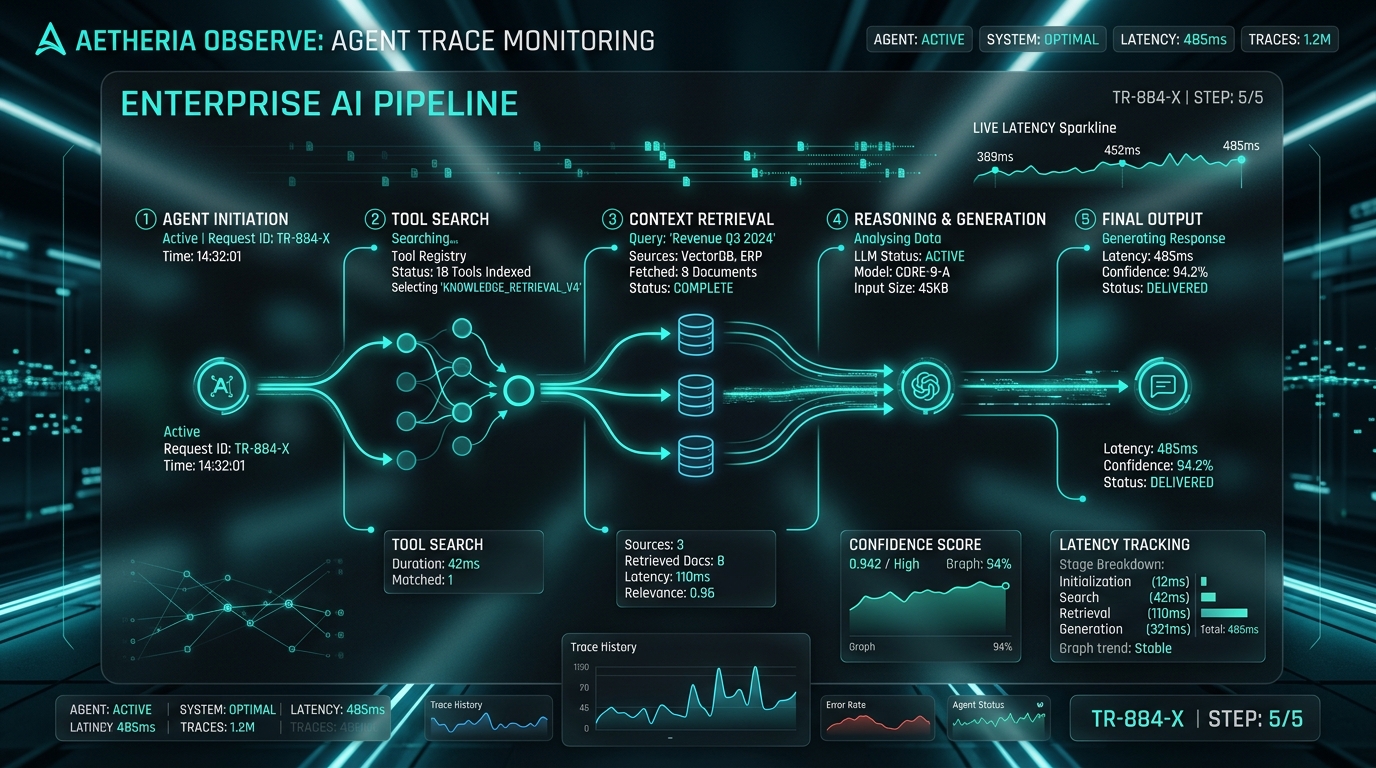
An AI agent is not one big brain. It is many small steps working together. It might search for information. Then pick the best pieces. Then write an answer. Then check its own answer. Each step can go wrong in a different way.
If you only look at the final answer, you miss where the problem started. It’s like tasting a finished cake and trying to guess which ingredient was bad. You need to watch the baking, not just taste the cake.
If you only inspect the final output, you cannot isolate which step went wrong. End-to-end trace visibility is necessary to locate the exact breakdown point.
2. What We Measure
Here are some of the things we track for every agent run:
Catching mistakes fast reveals systemic failure modes before they affect end users across thousands of live enterprise queries.
- 1. What the agent searched for — Did it search for the right thing? Sometimes an agent asks the wrong question to its own tools. If the search is bad, the answer will be bad too, even if everything after that step is perfect.
- 2. What information it found and used — We check which pieces of data the agent picked. Did it use the most relevant ones? Or did it grab something close, but not quite right?
- 3. How confident the answer really is — An AI can sound confident even when it is guessing. We look for signs that the answer is backed by real data, not just a smooth sentence.
- 4. How long each step took — Speed matters for a business tool. If one step is slow, users notice. We track this so slow parts do not hide in the background.
- 5. Where it failed, and how often — We do not expect zero mistakes. We expect to catch mistakes fast and see patterns. If the same kind of question keeps failing, that tells us where to fix things.
3. Why This Ties to Trust
Enterprise teams do not just want a good answer today. They want a tool they can trust every day. That trust comes from being able to check the agent’s work, the same way a manager checks a new employee’s work at first.
Without observability, you are just hoping the AI is doing a good job. With it, you know.
4. The Simple Truth
A good agent is not one that never makes mistakes. A good agent is one where you can see every step, catch problems early, and keep improving.
That visibility is not a nice extra feature. It is the foundation everything else stands on.
Summary & Takeaway
A good agent is not one that never makes mistakes. A good agent is one where you can see every step, catch problems early, and keep improving. That visibility is not a nice extra feature. It is the foundation everything else stands on.